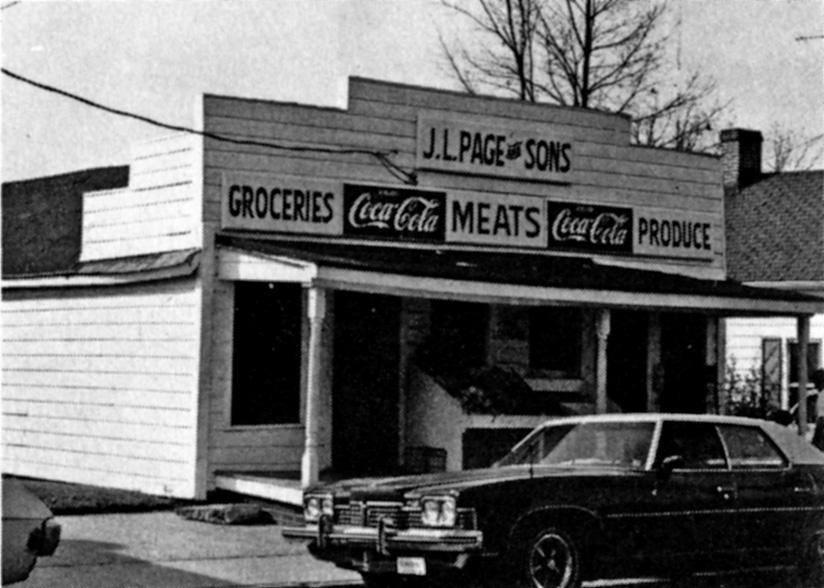
J.L. Page Grocery, late 1970s
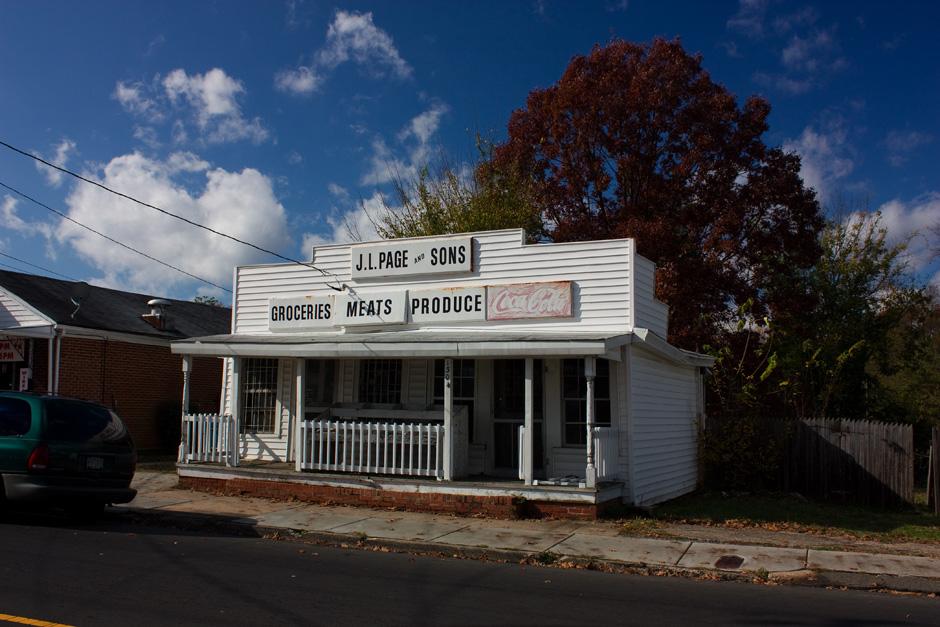
This one-story, front-gabled frame commercial building is two-bays wide and single pile. It appears to have lost its roof and be in deteriorating condition.
Previous photos show a a shed-roofed rear ell, a stone foundation, vinyl siding, a central chimney, and a stepped parapet roof, also covered with vinyl. There are two storefront doors, each flanked by six-over-six, double-hung wood sash windows. The left door is a two-light-over-three-panel wood door. The right door is a twelve-light-over-three-panel door. A shed-roofed porch extends across the façade, supported by original turned posts on the outside corners and replacement wood posts and railings between them.
1304 Fayetteville Street was a crucial epicenter of the Fayetteville Street Historic Corridor throughout the twentieth century. The property was home to J.L. Page Grocery, eventually J.L. Page and Sons Grocery, operated by James Lewis Page and his family. The store opened in 1907, and before its eventual closure, was one of the oldest operating grocery stores in Durham. J.L. opened the business based on the belief that “if a Black man was going to be free, he ought to be self-employed.” This was a central belief held in the Fayetteville Street Corridor, which was home to many crucial institutions owned by and serving Durham’s African American community, including North Carolina College (now North Carolina Central University), Lincoln Hospital, and the Biltmore Hotel. This community reliance ensured that African Americans did not have to depend on white power structures for support. Instead, they built up wealth and resources for and by African Americans, leading to the creation of the self-sustaining, prosperous Hayti community.
The grocery store was a small “country store,” but had a mighty impact as the Pages supported many of their community members by operating under a credit-based system. This system was especially beneficial during the Great Depression, when many people struggled to afford even basic necessities. Since the store wasn’t guaranteed to bring in enough income to support the Page family, J.L. would often peddle produce throughout the area on a horse and buggy.
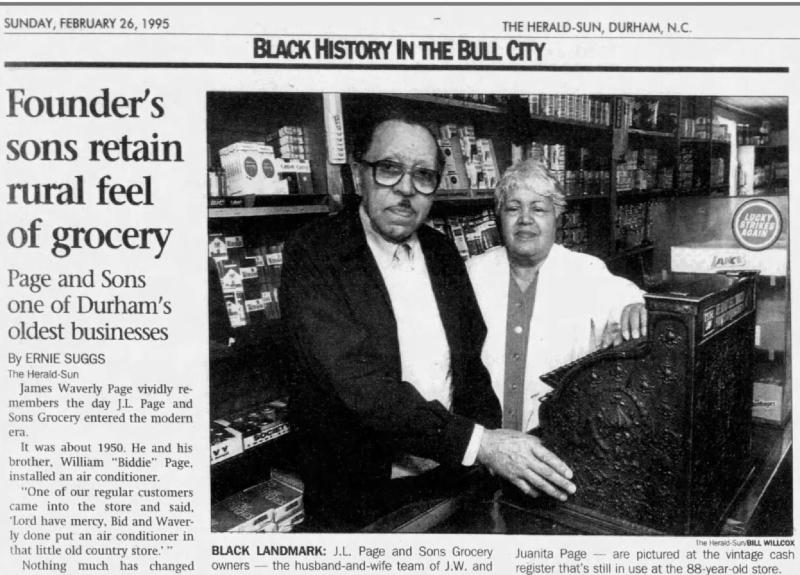
The grocery store remained true to its original structure and purpose throughout its history. Little changed in the store throughout the years, including the nearly 100-year-old cash register, a hallmark feature of the store. One of the few changes that did occur included a butcher’s shop addition during World War II, which was no longer in use before the store closed. One side of the structure was designated for the grocery store, whilst J.L.’s wife, Pearl, used the other to cook the family meals on an old wooden stove.
Much of what was sold at the grocery store was cultivated by the Page family, including vegetables, dairy products, and livestock. One of J.L. Page’s favorite products was watermelons, which he believed were “about one of the finest things you could sell.” The Pages also ran a wholesome operation, with a strict prohibition of the sale of alcohol. The store was open Monday-Saturday, courtesy of Pearl, who shut down J.L’s attempt to sell ice cream on Sundays, the Sabbath.
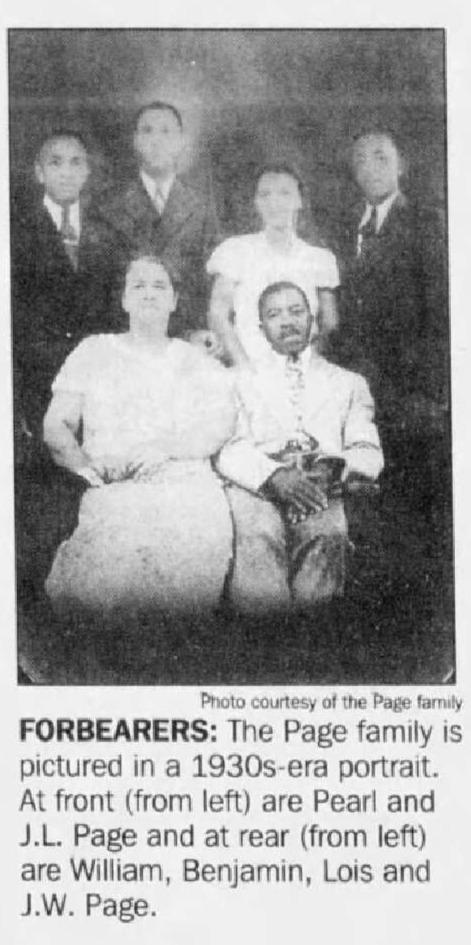
When J.L. Page passed away in 1942, Pearl took over running the business, with two of the Page sons, James Waverly Page and William Douglas “Biddie” Page, eventually co-owning the store. The store was a family operation, with all four of the Page children helping out, even their only daughter, Lois, whom J.L. did not like working at the store because he deemed it unsuitable for girls. Their third child, Benjamin, while having a career outside of the grocery store, also helped support the family business. Pearl passed away in 1973, and Biddie shortly after in 1979. J.W.’s wife, Margaret Juanita Page, was also crucial in helping run the grocery store, especially after Pearl and Biddie passed. J.W. retired from the business at age 88 and passed away a few years later in 2004. J.W.’s retirement and death were a likely impetus for the grocery store eventually closing down.
Today, the grocery store is no longer in operation, and the structure is in critical condition.
Sources:
W.E.B Dubois, The Upbuilding of Black Durham: The Success of the Negroes and Their Value to a Tolerant and Helpful Southern City: (World's Work vol. 23, Jan. 1912), https://docsouth.unc.edu/nc/dubois/dubois.html.
Herald-Sun
Carolina Times
Looking southwest, 11.15.08
Find this spot on a Google Map.
35.980976,-78.899557

Comments
Submitted by Dave Piatt (not verified) on Wed, 12/3/2008 - 6:28pm
There is actually a small barn behind the current structure, as well, which appeared to possibly contain some sort of livestock at one time. there is still coal littering the floor of the structure, from the days when such things were used for heat.
I began working over there about eight years ago. It has been empty and unused for at least that long.
Submitted by 306West (not verified) on Sat, 7/31/2010 - 1:51pm
I remember going there for simple groceries (fresh fruits/veggies...seasonal of course at that time). The Page family is still here in Durham by the way.
Also, now this maybe just me, but, Page Grocery wasn't truly within the Hayti business line/area, it was definitely up the street from where that line started (going towards NCCU), and it was just one of several little neighborhood grocers (there were even side pockets of these stores), going towards NCCU.
Submitted by Gerrie (not verified) on Fri, 5/25/2012 - 1:52pm
I remember stopping at Page's Store after school. Students from Whitted Junior High and Hillside High School would gather there for snacks before going home. One day out of the week we would all go over to W.D. Hill Recreation for a dance that was held.
Mr. Theodore Freeland was one of the managers in the recreation center. Those were fun times.
Add new comment
Log in or register to post comments.